
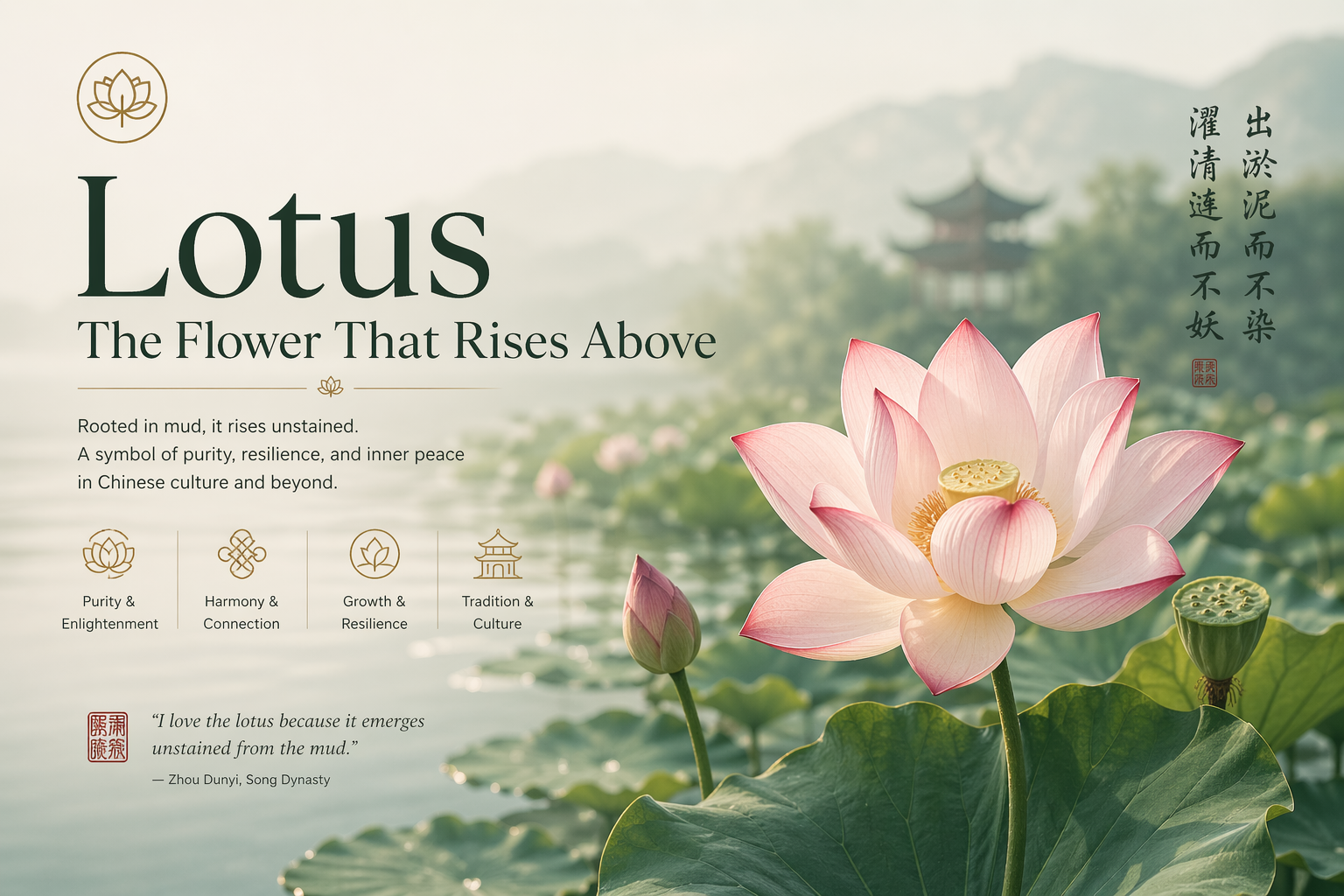
If you’ve ever seen a lotus bloom in person, you’ll understand why it’s more than just a flower in Chinese culture—it’s a quiet philosophy, a way of seeing the world.
The lotus grows in muddy water, rooted deep in the dark silt of ponds and lakes. Yet somehow, it rises clean and unblemished to the surface, unfolding petals that look almost too perfect to be real. It doesn’t hide where it came from. It simply transforms it.
That idea—of rising above your circumstances without denying them—is at the heart of what the lotus represents.
A Flower with a Story
In China, the lotus (莲, lián) has been admired for thousands of years. One of the most famous lines about it comes from the Song Dynasty scholar Zhou Dunyi, who wrote that he loved the lotus because it “emerges unstained from the mud.” That single sentence shaped how generations came to see the flower—not just as beautiful, but as honorable.
There’s also a softer layer of meaning. The word lián sounds similar to words for “connection” and “continuity,” which is why lotus motifs often appear in art and gifts meant to symbolize harmony, love, and lasting relationships.
And then there’s the spiritual side. In Buddhist traditions, the lotus is everywhere—from temple carvings to meditation imagery. It represents purity of mind and the idea that enlightenment is possible, even in an imperfect world. You don’t need perfect conditions to become something meaningful.
Everyday Beauty, Quietly Present
What’s interesting is that the lotus isn’t locked away in temples or history books. It shows up in everyday life.
You’ll find it in traditional paintings, embroidered onto silk, carved into jade pendants, or shaped into delicate tea ware. It’s also a familiar ingredient in Chinese kitchens—lotus root, with its lace-like pattern, is both nourishing and symbolic, often served during family meals and festivals.
In summer, lotus ponds become places people return to again and again. Not for spectacle, but for a kind of calm. Watching a lotus bloom is a slow experience. It asks you to pause.
Why It Still Matters Today
In a fast-moving, always-on world, the lotus feels surprisingly relevant.
It doesn’t rush. It doesn’t compete. It simply grows, steadily, quietly, until one day it blooms.
That’s probably why lotus-inspired pieces—whether it’s a small pendant, a bracelet, or even a simple illustration—resonate with so many people today. They’re not just decorative. They carry a reminder: you can move through difficult environments without losing your sense of self.
For those building a personal ritual—whether it’s mindfulness, journaling, or just taking a few minutes to breathe—the lotus becomes more than a symbol. It becomes a companion.
A Personal Reflection
The first time I saw a lotus pond in full bloom, it wasn’t dramatic. No grand moment, no sudden realization. Just a quiet morning, a bit of mist, and dozens of flowers opening one by one.
What stayed with me wasn’t the beauty alone—it was the feeling that growth doesn’t have to be loud to be meaningful.
That’s the essence of the lotus.
It doesn’t deny the mud.
It doesn’t rush the bloom.
It simply becomes what it was meant to be.
And maybe that’s why, across centuries and cultures, people keep coming back to it.
Comments (0)
Please login to leave a comment
No comments yet. Be the first to comment!